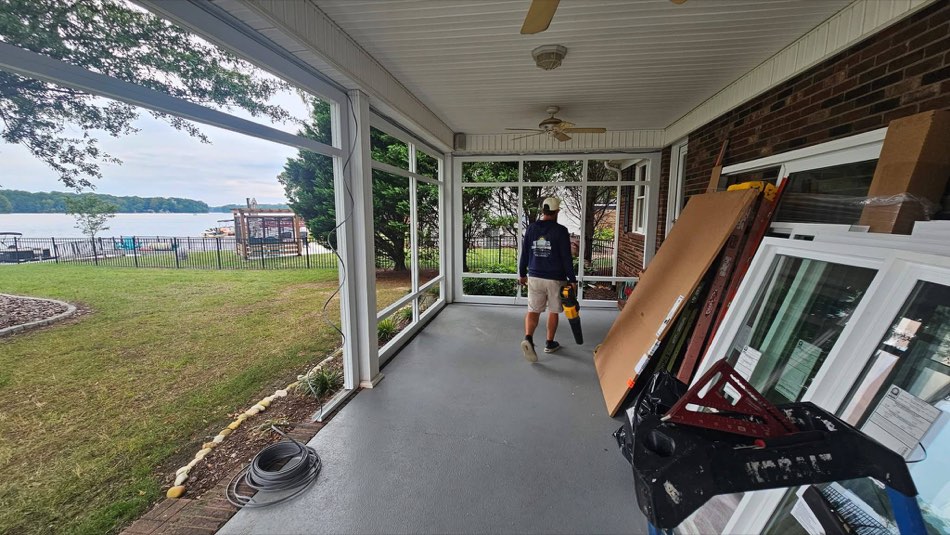
If you're thinking about adding a sunroom to your Lowcountry home, the first decision isn't about glass or framing. It's about how many seasons you want to use it.
A three-season sunroom is a glass-walled outdoor room you'll use about nine months of the year, June through early September aside. A four-season addition is fully insulated, heated, cooled, and counts as conditioned square footage on your house. The price gap between them is real, but so is the use gap.
Here's what a Lowcountry contractor actually walks through when scoping a sunroom build in Savannah, Bluffton, Hilton Head, or anywhere between Beaufort and Statesboro.
Three-season sunrooms are faster to build, lighter on permits, and use less material. Four-season additions add to your conditioned square footage (which a buyer values), tie into your HVAC, and let you actually live in the room in August humidity and December cold snaps. Most Lowcountry homeowners pick the one their primary use case actually needs — not the one with the lower upfront number.
The two paths in 60 seconds
Three-season sunroom
A glass-paneled room (single-pane or vinyl windows) with a finished ceiling and floor, ceiling fan, and basic electrical. No HVAC tie-in. Usable nine to ten months a year in coastal Georgia. Great for morning coffee, evening reading, watching marsh sunrises, and three-quarters of the entertaining you'd want to do outside. Permitted lighter, built faster.
Four-season addition
Insulated walls, double-pane insulated glass, fully heated and air-conditioned through your home's existing HVAC system (or a separate mini-split). Counts as conditioned square footage on your property tax assessment and on your future MLS listing. Usable 365 days a year. Built to full code as a habitable room.
Lowcountry climate considerations
What works in a Pennsylvania sunroom catalog doesn't always survive a Savannah summer. Three things drive material choices here:
Humidity (the constant)
From May through October, ambient humidity sits at 80%+ for most of the day. A sunroom that doesn't have cross-ventilation OR climate control turns into a greenhouse fast. Three-season builds need ceiling fans rated for damp locations and at least two operable windows positioned for cross-breeze. Four-season builds need a dehumidifier integrated into the HVAC return or a moisture problem will develop in the wall cavities within five years.
Hurricanes and tropical systems
Every glass panel, frame, and roof tie-in on a Lowcountry sunroom needs to be rated for the wind zone your home sits in. Coastal Chatham, Bryan, and Effingham counties require impact-rated glass or shutter systems on most new construction. Beaufort and Jasper requirements vary by parcel. A real local contractor will know the exact code your job has to meet and won't try to talk you out of it.
Salt air
Aluminum frames in a coastal Lowcountry sunroom need a marine-grade finish or they'll pit and corrode within a few years. The cheapest aluminum systems on the market are not designed for our environment — we've seen 5-year-old sunrooms with corroded frame channels that needed full reframing. Vinyl frames don't have this problem.
Roof tie-in — where most sunrooms fail
The wall-to-wall and roof-to-roof connections between your existing house and the new sunroom are where almost every sunroom leak originates. A good install includes:
- Stepped flashing, not just caulk, where the new roof meets your home's existing siding
- An ice and water shield underlayment running 24"+ up the wall and across the entire new roof
- Matched shingle color and weight so the roof line reads as intentional, not bolted-on
- Proper sloping (typically 1/4" per foot minimum) so rain sheds toward gutters, not toward the wall connection
- A drip edge that ties into your existing gutter system or has its own gutter run
If you've ever seen a sunroom with water staining on the inside ceiling near the house wall, the roof tie-in was the failure point.
Glass choices that matter in the Lowcountry
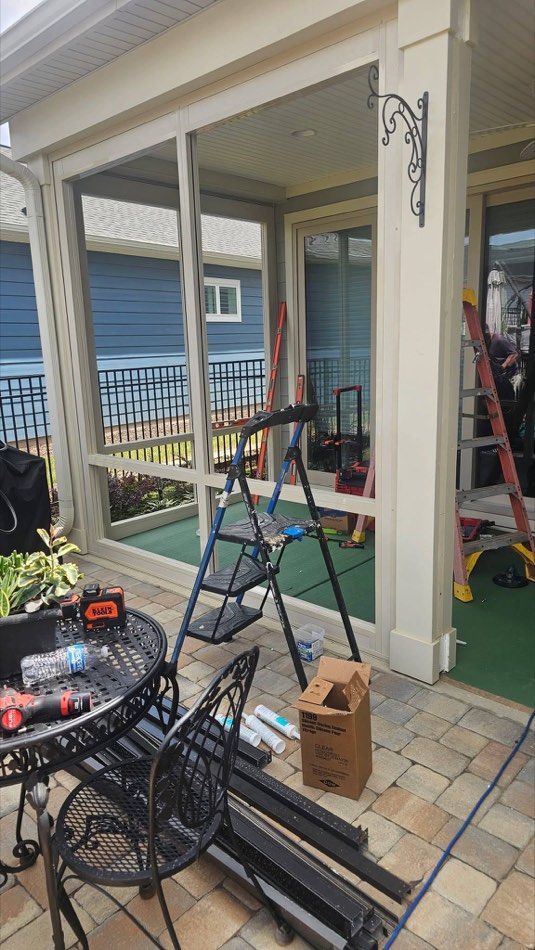
Single-pane (three-season only)
Standard tempered safety glass. Cheaper, lighter on the frame. Doesn't insulate well, which is fine for a three-season room where you'll close it up during winter cold snaps and turn off the fan in August anyway. Works fine with the right shading and cross-ventilation.
Double-pane insulated (four-season standard)
Two glass panes with an air or argon gap between. Required for any room you'll heat or air-condition. Reduces sound transfer (real if you're near a road), blocks more UV (your furniture and floors will thank you), and prevents condensation problems on cold mornings.
Low-E coating
Worth the upgrade on south- and west-facing sunrooms. A thin metallic coating reflects infrared heat in summer and reflects heat back inward in winter. Adds slightly to the glass cost; subtracts significantly from your HVAC bill on a four-season build.
Tempered vs. impact-rated
Tempered is the safety standard (breaks into rounded pieces instead of shards). Impact-rated has an interlayer of plastic between two tempered panes — required in many Lowcountry coastal zones for hurricane resistance. Your contractor should know which zone your house sits in.
HVAC: tied in or separate?
For a four-season addition, you have two options:
Tie into existing HVAC
If your home's HVAC system has the capacity, extending a duct run into the new room is cheapest. The catch: most existing residential systems are sized for the existing square footage, not the addition. Adding 200+ sq ft of conditioned space can leave the rest of your house struggling on the hottest days. Get a load calc done before you commit.
Dedicated mini-split
A small ductless heat pump (Mitsubishi, Daikin, Fujitsu, LG) installed just for the sunroom. Costs more upfront but you get independent temperature control, doesn't burden your main system, and lets you cool just that room when you're using it. Most quiet residential models you can barely hear running. For most Lowcountry four-season builds, this is what we recommend.
Foundations — what's under the floor
Three options, in roughly increasing cost order:
- Concrete slab on grade — works for most three-season builds, especially on flat coastal lots. Easy, fast, low-cost.
- Pier and beam foundation — concrete piers with a wood-framed floor system on top. Better airflow underneath (matters in our humidity), allows utilities to run under the floor for plumbing or wiring.
- Crawl space matched to your existing house — for four-season builds where you want the sunroom to feel like part of the original house. Most expensive, best long-term integration.
If your home is elevated on piers (common in Bluffton, Beaufort, and coastal Hilton Head), a sunroom on a concrete slab will look bolted-on. Match the foundation to the rest of your house.
Permitting and timeline
Every county we build in — Chatham, Bryan, Effingham, Beaufort, Jasper — requires a permit for new sunrooms over 200 sq ft, any sunroom with electrical, and any sunroom adding to the home's footprint. Permitting timelines run two to six weeks depending on the county and how busy the inspector's office is. We pull the permit, coordinate the inspections, and you sign the certificate of occupancy at the end. Don't hire a contractor who suggests skipping permits to save time.
A typical Lowcountry three-season sunroom build, from contract signing to walkthrough, runs four to six weeks once the permit is in hand. A four-season addition runs eight to twelve weeks because of the additional rough-in inspections, insulation, and HVAC work.
What about screened porches?
Worth mentioning because most Lowcountry homeowners considering a sunroom are also considering a screened porch.
A screened porch is faster, lighter on permits, costs significantly less, and gives you outdoor air with bug protection — which is the actual reason most Lowcountry people want outdoor space. A glass sunroom is closer to indoor space with a view of outdoors.
If you spend most of your outdoor time at dusk and dawn during bug season (April through October), a screened porch might be the better build for your use. If you want a year-round indoor room with light, a sunroom is the right call.
What we'd build on our own house
For most Lowcountry homeowners on a primary residence: a four-season addition with double-pane low-E glass, vinyl frames, a dedicated mini-split, and a matched-shingle roof tie-in. Permitted, inspected, signed off, and built to last 25+ years. It adds usable conditioned square footage to your house, which appraisers and buyers actually value.
For a vacation home or second property: a three-season vinyl-frame sunroom with single-pane operable windows and ceiling fans for cross-breeze. Lighter build, lower commitment, still 9 months of use a year.
If you want a real number for your specific house, we walk the property, measure the wall and roof tie-in points, look at your existing HVAC capacity, and write up a fixed quote.