He had already paid for this floor once. His insurance sent out a contractor, the work got done cheap and fast, and within a short time the living room started to give. By the time he called us, walking across his own house felt like stepping on a mattress.
Too soft everywhere, and getting softer every week. You feel it in your knees and you feel it in your stomach, and after a while you just stop trusting your own house. That is a stressful way to live, and it had been going on long enough that he was past frustrated.
His wife was very uncomfortable on that floor. The two of them could not handle it anymore, so they called us.
They figured they would be waiting a month for somebody. We got them started right away. A floor that far gone is not something that sits on a waiting list.
The flooring was never the problem
This is the part that catches most homeowners off guard. When a floor sinks or feels spongy, the surface you are looking at is almost never the cause. It is the structure underneath. In this house the floor joists had failed. Somewhere along the way they cracked and sagged, and once a joist gives up, everything sitting on top of it goes with it. The subfloor followed the sag. The finished floor followed the subfloor.
The previous contractor had put new flooring over a bad structure. That is why it went soft again so quickly. You can lay the most expensive plank on the market over a failing joist and you will be back where you started inside a year. There is no product that covers for framing that cannot hold.
How to tell if it is structural
It moves when you walk. Not a creak. Actual give, like the floor is flexing under your weight.
It is worse in the middle of the room. That is the longest unsupported span, so that is where a weak joist shows first.
Doors start catching. When the floor drops, door heights and thresholds go out with it.
New flooring did not fix it. If somebody already replaced the surface and the soft spot came back, the framing is the problem.
Opening it up
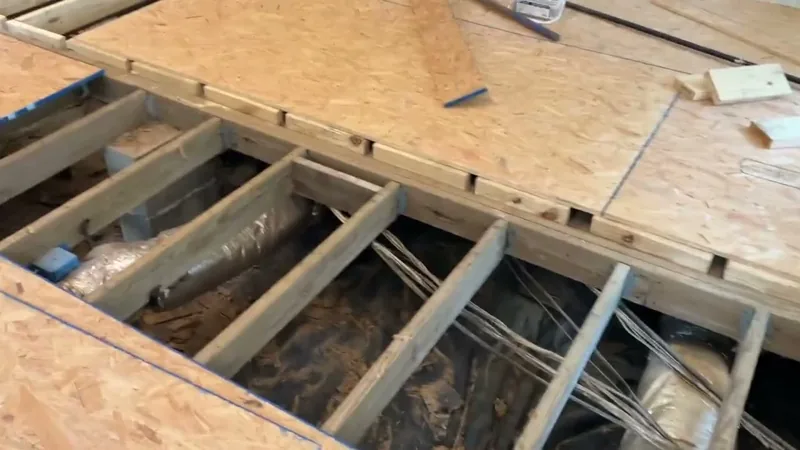
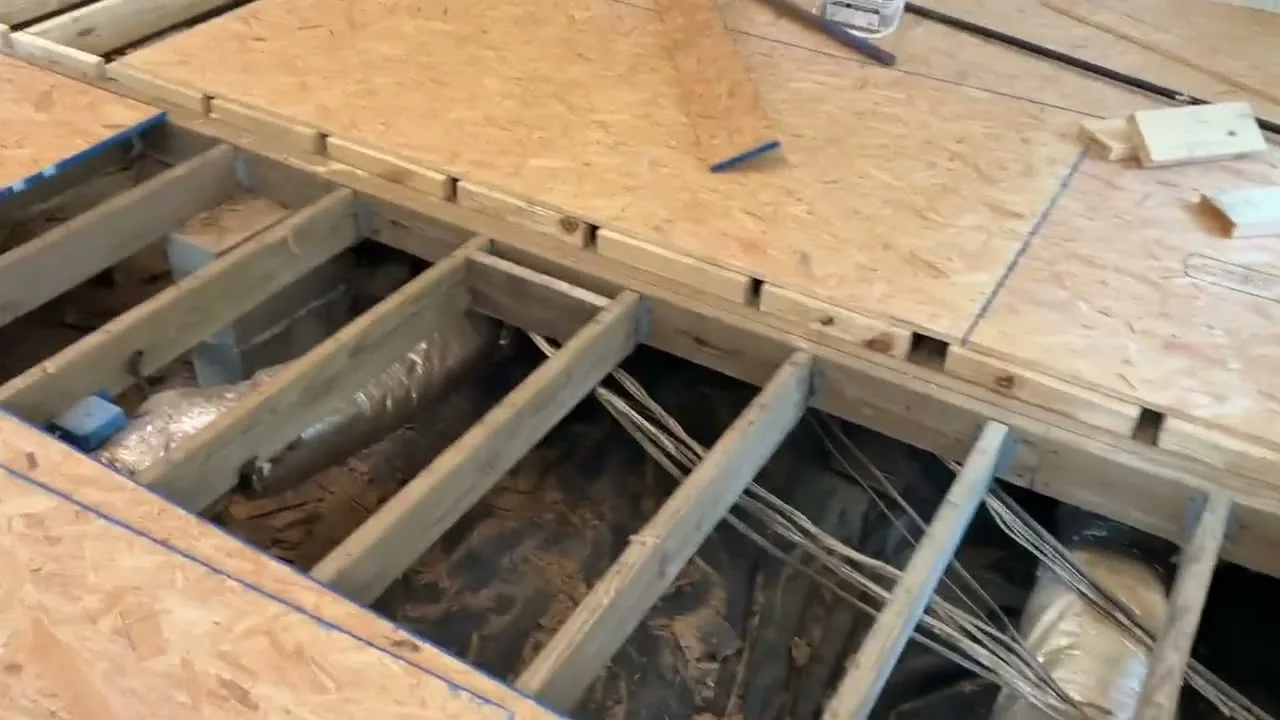
The only honest way to fix this is to see it. So we pulled the flooring and the old subfloor out and got the whole thing open, right down to the joists and the crawlspace below. That first video up top is exactly what that looks like. It is dirty, loud work, and it is the step a lot of outfits try to skip because it costs them time.
With it open we could finally read the floor properly. We could see which joists had gone, how far the sag ran, and what the moisture underneath was doing. In our part of Georgia that last one matters. Effingham and Chatham County crawlspaces hold humidity, and wood that stays damp gives up years before it should.
Sistering the joists
The fix for a failed joist is called sistering. You cut a new full length joist, set it tight alongside the damaged one, bring it back up to level, and fasten the two together so the new lumber takes the load. Done properly the repaired framing is as strong as new construction, and it does it without tearing out the whole floor system.
That is the second video. New light colored lumber running right beside the old dark framing, every one of them set true and level, and the new subfloor sheets going down on top. Once those sheets are fastened down the whole room stops moving. You can feel the difference the moment you step on it.
We also leveled the floor as we went. There is no point putting down a beautiful new surface if the plane it sits on still dips.
LVP over a floor that finally deserved it
With solid framing and a flat, dry subfloor, the luxury vinyl plank could go down the way it is supposed to. LVP is a great fit for Lowcountry homes. It is waterproof, it shrugs off scratches and pets and kids, it looks like wood, and it stays stable when the humidity swings the way it does here. But it is only as good as the substrate under it. Over a bad subfloor it telegraphs every dip and the seams work apart. Over a solid one it lasts.
Because the floor came up to its correct height, we raised and re-set the door so it swings clean over the new surface, and we ran new baseboard around the room to finish it off. Those two details are what separate a repair that looks like a repair from one that looks like the floor was always meant to be that way.
What we did
The scope
Demo
Old flooring and failed subfloor removed down to the framing, full living room.
Structural
Full joist rebuild. New sister joists set alongside the failed framing, brought back to level and fastened tight.
Subfloor
New subfloor sheathing installed and leveled across the entire span.
Finish
New LVP laid throughout, door raised and re-set to the new floor height, new baseboard installed.
Location
Springfield, GA, Effingham County. Single family home, main living area.
If your floor is doing this, do not wait
A soft floor is not a cosmetic complaint. It is a structural one, and it gets worse and more expensive the longer it runs. Water keeps working. The sag keeps spreading to the joists on either side. And every day in between, somebody in that house is walking on a floor they do not trust.
We handle the whole thing with one crew, from the demo through the framing repair to the finished floor and baseboard. Same people, start to finish, so nobody gets to point at somebody else when something goes wrong. If you are in Springfield, Rincon, Guyton, Savannah, Pooler, Richmond Hill, or across the water in Bluffton and Beaufort, we will come walk the floor with you and tell you straight what it needs. The estimate is free and we put it in writing.
Zero surprises. That is the whole point.